A Brief Overview
A decade ago, 'move everything to the cloud' was the default answer to almost any infrastructure question. And for many use cases, that answer still holds. But as billions of connected devices flood the world with data — from factory floors and hospital wards to autonomous vehicles and retail stores — a new reality is emerging: not all data should travel to a distant server before it is acted upon.
This is the core tension behind edge computing vs cloud computing. It is not a battle between old and new. It is a question of where intelligence should live — at the centre of the network, or right at its edge.
Understanding both models and knowing when to use each is one of the most consequential infrastructure decisions organizations face today. This guide gives you the full picture.
What Is Cloud Computing?
Cloud computing is the on-demand delivery of computing resources — servers, storage, databases, networking, software, and analytics — over the internet, typically from large, centralized data centres operated by providers such as AWS, Microsoft Azure, or Google Cloud.
Rather than owning and managing physical hardware, organizations subscribe to capacity they need, scale it on demand, and pay only for what they consume. It fundamentally changed how software is built and delivered over the past fifteen years.
Core Characteristics
Centralized infrastructure
Hosted in geographically distributed data centres
Elastic scalability
Spin up or shut down resources within minutes
Pay-as-you-go pricing
No upfront hardware expenditure
Managed services
Providers handle maintenance, patches, and uptime SLAs
Global accessibility
Access applications and data from anywhere with internet connectivity
What Is Edge Computing?
Edge computing moves data processing closer to where data is actually generated — at or near the 'edge' of the network. Instead of routing data to a central cloud server, edge devices such as routers, IoT gateways, local servers, and embedded processors analyze data on-site and deliver results immediately.
Core Characteristics
Distributed architecture
Compute nodes placed at or near data sources
Ultra-low latency
Local processing typically under 5 milliseconds
Reduced bandwidth
Only relevant insights travel upstream to the cloud
Offline capability
Continues operating without a live internet connection
Real-time decision-making
Essential for time-critical, autonomous systems
Edge vs Cloud: At a Glance
Before diving into the details of each dimension, here is a structured overview of how the two models compare across the criteria that matter most to infrastructure decisions:
The Real Benefits — What Each Model Actually Delivers
Cloud computing's greatest strength is its combination of scale and accessibility. Organizations can go from zero to global infrastructure in hours, without owning a single server. This has democratized technology — a two-person startup can run on the same infrastructure class as a Fortune 500 company.
-
Elastic scalability
Handle traffic spikes in real time without over-provisioning
-
Reduced capital expenditure
Infrastructure becomes an operational cost, not a capital burden
-
Built-in resilience
Multi-region redundancy, automated backups, and disaster recovery
-
Advanced AI and analytics
Pre-built ML platforms, data lakes, and GPU clusters on demand
-
Global collaboration
Distributed teams access the same systems and data simultaneously
Where Each Model Wins: Real-World Use Cases
Cloud delivers maximum value where workloads are variable, datasets are large, or global delivery matters. Key applications include:
Looking to modernize your infrastructure strategy?
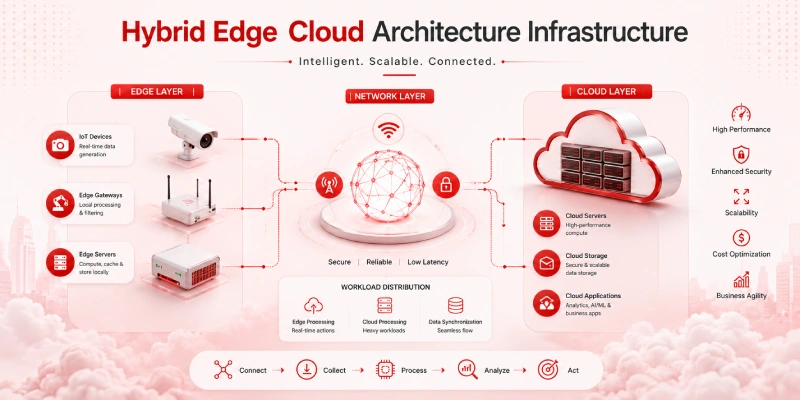
The Convergence: Why the Answer is Usually Both
The most forward-thinking infrastructure strategies today are not choosing between edge and cloud — they are designing hybrid edge-cloud architectures that assign each workload to the tier where it runs best.
In a well-designed hybrid model, edge nodes handle time-critical local tasks — anomaly detection, real-time automation, on-site data filtering. Cloud platforms manage the broader picture — aggregating data from multiple edge sites, training AI models centrally, and delivering enterprise-wide analytics and reporting.
The two tiers communicate continuously: the cloud pushes updated AI models and configuration to edge nodes; the edge sends compressed, filtered insights upstream to feed the cloud's analytical engines. Together, they form a single, intelligent system.
Edge Nodes
Real-time tasks, anomaly detection, local filtering
Cloud Platform
Model training, analytics, enterprise reporting
Challenges to Evaluate Before You Commit
Edge Computing Challenges
Edge is not without complexity. Distributed deployments introduce operational overhead that centralized cloud architectures avoid:
-
Hardware management at scale
Deploying, patching, and monitoring thousands of distributed nodes requires dedicated operations capability
-
Expanded attack surface
More endpoints mean more vectors; edge security demands rigorous endpoint management and network segmentation
-
Compute constraints
Edge nodes cannot match the raw processing power of cloud data centres; large model training is not feasible at the edge
Cloud Computing Challenges
Cloud is not universally the safer choice either. Common pitfalls include:
-
Latency ceiling
Unsuitable for sub-10ms applications regardless of optimization
-
Vendor lock-in
Migrating between cloud providers can be technically complex and commercially costly
-
Cost sprawl
Without disciplined FinOps governance, cloud costs can grow faster than the workloads they support
Frequently Asked Questions
Conclusion
Edge computing and cloud computing are complementary pillars of a modern infrastructure strategy, not competing alternatives. Cloud delivers unmatched scalability, global reach, and analytical depth. Edge delivers speed, autonomy, and local intelligence where latency or connectivity constraints make centralized processing impractical.
The organizations that will lead the next decade are designing infrastructure that is both — deploying edge where real-time action is non-negotiable, and leveraging cloud where scale and depth create competitive advantage.
The question has shifted. It is no longer 'edge or cloud?' — it is 'how do we architect both to operate as one intelligent, resilient system?'